
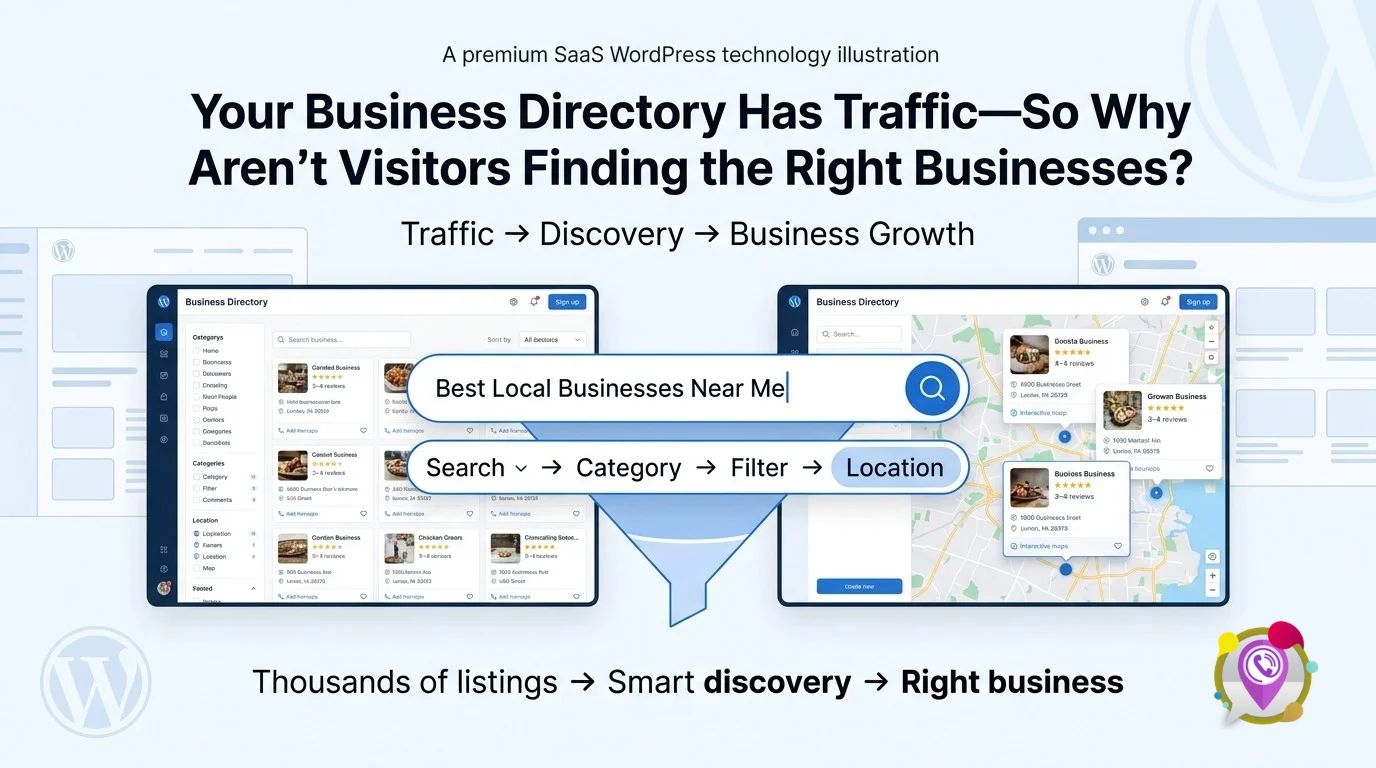
Your Business Directory Has Traffic—So Why Aren’t Visitors Finding the Right Businesses?

Latest News and Blog on Website Design and Bangladesh.

Your Business Directory Has Traffic—So Why Aren’t Visitors Finding the Right Businesses?
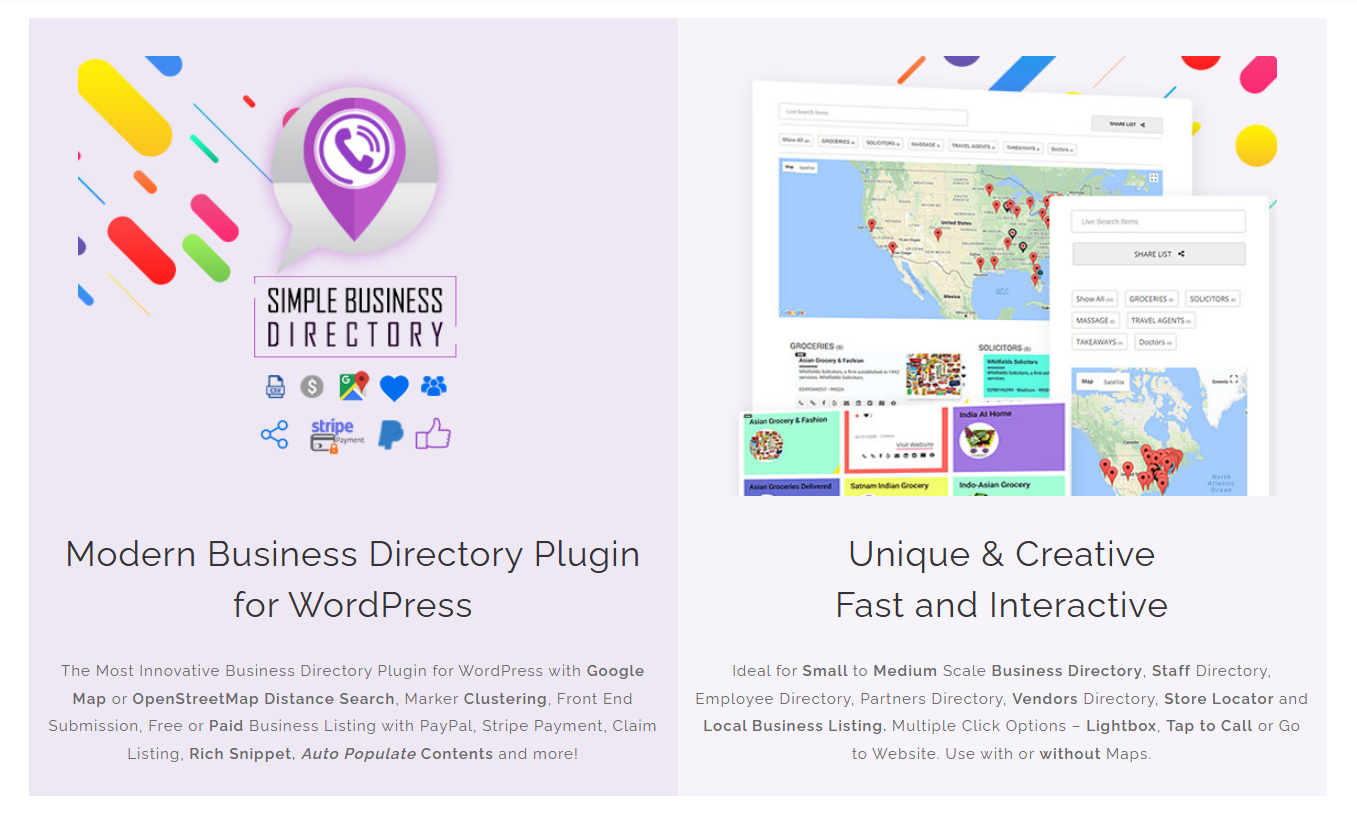
Simple Business Directory (SBD) helps WordPress site owners organize business listings into a searchable, structured directory where visitors can discover relevant businesses through categories, search, filters, locations, and listing information. Simple Business Directory (SBD) also gives directory owners tools for managing business listings while creating opportunities for SEO visibility, local discovery, and business growth. Traffic is not the same thing as discovery. A directory can attract thousands of visitors every month and still fail to connect visitors with the businesses visitors actually want. Simple Business Directory (SBD) addresses the gap by improving how visitors search, how business information is organized, and how individual listings can become discoverable entry points from search engines. Why Does Directory Traffic Fail to Produce Business Discovery? Simple Business Directory (SBD) treats visitor discovery as a usability problem rather than a traffic problem. Simple Business Directory (SBD) focuses on helping visitors move from a broad directory visit toward a relevant business, location, category, or listing. Simple Business Directory (SBD) becomes especially useful when a directory grows beyond a small collection of listings. A directory containing 50 businesses can sometimes be browsed manually, while a directory containing 500 or 5,000 businesses needs stronger information architecture and discovery mechanisms. Simple Business Directory (SBD) therefore connects three separate requirements: Business Discovery & Visitor Experience, Business Listings & Directory Management, and SEO, Local Visibility & Business Growth. Directory problem Simple Business Directory (SBD) response Business outcome Visitors cannot locate relevant businesses Simple Business Directory (SBD) supports directory discovery through search and structured browsing Faster business discovery Listings become difficult to manage Simple Business Directory (SBD) organizes business information into directory listings Better directory quality Businesses receive limited organic exposure Simple Business Directory (SBD) creates structured business-listing pages More opportunities for search visibility Visitors struggle with local discovery Simple Business Directory (SBD) supports location-focused business discovery Stronger local navigation Directory growth creates information overload Simple Business Directory (SBD) combines categories, listings, search, and filtering More scalable discovery Is Your Business Directory Making Visitors Search Too Hard? Simple Business Directory (SBD) reduces directory friction by giving visitors structured ways to narrow a large collection of businesses. Simple Business Directory (SBD) can turn an overwhelming list into a discovery path based on what a visitor needs. Simple Business Directory (SBD) works best when directory navigation answers practical questions such as “Which business provides this service?”, “Which businesses are near this location?”, and “Which listing matches these requirements?” Simple Business Directory (SBD) can therefore make directory discovery more intentional instead of forcing visitors to scan pages of unrelated listings. How Can Simple Business Directory (SBD) Turn Browsing Into Discovery? Simple Business Directory (SBD) can support a visitor journey that looks like: Search → Category → Filter → Location → Business Listing → Contact or Visit Simple Business Directory (SBD) makes each stage useful because every stage reduces the number of irrelevant choices presented to the visitor. Simple Business Directory (SBD) gives directory owners a practical way to think about discovery: every search, category, filter, and location choice should move a visitor closer to a relevant business. Why Does Business Discovery & Visitor Experience Matter So Much? Simple Business Directory (SBD) makes Business Discovery & Visitor Experience the first major pillar because directory visitors usually arrive with a specific discovery goal. Simple Business Directory (SBD) supports a discovery experience where visitors can move through business categories, search results, locations, and individual listings instead of relying entirely on manual browsing. Why Is Search More Important as Simple Business Directory (SBD) Grows? Simple Business Directory (SBD) becomes increasingly valuable when a directory contains hundreds or thousands of listings. Simple Business Directory (SBD) can help visitors locate relevant businesses without requiring visitors to inspect every available listing. Simple Business Directory (SBD) can make search particularly useful when business names, services, locations, or categories provide meaningful search signals. A visitor searching for “Italian restaurant” has a very different discovery intent from a visitor searching for “accountant in Dhaka,” and Simple Business Directory (SBD) can support a directory structure designed around those discovery patterns. Can Simple Business Directory (SBD) Reduce Directory Search Friction? Simple Business Directory (SBD) reduces search friction by giving visitors structured ways to narrow business results. Simple Business Directory (SBD) can combine search, categories, filters, and location-based discovery so visitors can move from a large directory collection toward a smaller relevant result set. Simple Business Directory (SBD) also helps directory owners think beyond listing quantity. A directory containing 1,000 listings can be less useful than a directory containing 300 well-organized listings if visitors cannot find relevant businesses. How Do Categories Improve Simple Business Directory (SBD) Discovery? Simple Business Directory (SBD) uses categories as an information-architecture layer that groups businesses according to meaningful business types or services. Simple Business Directory (SBD) categories can reduce the cognitive load created by presenting visitors with a single undifferentiated list. Simple Business Directory (SBD) category structures should remain intuitive because overly complicated category systems can create another form of navigation friction. Simple Business Directory (SBD) directory owners should use categories that match the language visitors naturally use when looking for businesses. How Can Simple Business Directory (SBD) Make Local Discovery More Useful? Simple Business Directory (SBD) can connect business discovery with location-based intent. Simple Business Directory (SBD) becomes especially relevant for directories covering restaurants, service providers, shops, agencies, professionals, healthcare businesses, accommodation providers, and other location-dependent businesses. Simple Business Directory (SBD) location information can help visitors answer practical questions such as where a business operates, whether a business is nearby, and which businesses serve a particular area. Why Do Maps Matter in Simple Business Directory (SBD) Discovery? Simple Business Directory (SBD) can make location information more useful when directory visitors need geographical context. Simple Business Directory (SBD) location and map functionality can complement textual search by showing where businesses are located. Simple Business Directory (SBD) map-based discovery is particularly useful when proximity influences purchasing decisions. A visitor choosing a restaurant, repair service, clinic, hotel, or local professional may care about distance as much as business category. What Does a Better Simple Business Directory (SBD) Visitor Journey Look Like? Simple Business Directory (SBD) can support a visitor journey built around progressively more specific information: 1. Simple Business Directory (SBD) starts with a broad directory discovery experience. 2. Simple Business Directory (SBD) narrows discovery through categories. 3. Simple Business Directory (SBD) narrows results further through search or filters. 4. Simple Business Directory (SBD) adds location context when location affects relevance. 5. Simple Business Directory (SBD) presents detailed business information through an individual listing. 6. Simple Business Directory (SBD) gives visitors the information needed to contact, visit, or investigate the business. The important point is that Simple Business Directory (SBD) does not need to make every visitor follow the same path. Simple Business Directory (SBD) can support multiple discovery routes because different visitors arrive with different search intent. Why Does Business Listings & Directory Management Determine Directory Quality? Simple Business Directory (SBD) makes Business Listings & Directory Management the second core pillar because visitor discovery depends on the quality of the underlying business information. Simple Business Directory (SBD) cannot create useful discovery from incomplete, duplicated, outdated, or poorly categorized business information. Simple Business Directory (SBD) directory management therefore becomes part of the visitor experience rather than a purely administrative task. Why Aren’t More Simple Business Directory (SBD) Listings Always Better? Simple Business Directory (SBD) directory growth creates value only when additional listings remain useful and discoverable. Simple Business Directory (SBD) owners should measure directory quality through listing completeness, relevance, organization, and discoverability rather than listing count alone. Simple Business Directory (SBD) can make a 2,000-listing directory valuable when visitors can efficiently locate relevant businesses. Simple Business Directory (SBD) can also expose the weaknesses of a 2,000-listing directory when categories, locations, descriptions, and search paths are poorly structured. What Information Should a Simple Business Directory (SBD) Listing Contain? Simple Business Directory (SBD) listings should contain the information visitors need to evaluate a business. Simple Business Directory (SBD) business profiles can include business names, descriptions, categories, locations, contact information, images, and other relevant business details depending on the directory configuration. Simple Business Directory (SBD) listing completeness matters because visitors make decisions using information, not listing counts. Simple Business Directory (SBD) gives directory owners a structure for presenting business information in a more consistent format. How Does Simple Business Directory (SBD) Help Organize Growing Directories? Simple Business Directory (SBD) can provide a management structure for directories that continue adding businesses over time. Simple Business Directory (SBD) gives directory owners a framework for managing individual business entries rather than treating the directory as a collection of unrelated pages. Simple Business Directory (SBD) becomes particularly useful when multiple business types, locations, and categories coexist. Simple Business Directory (SBD) organization helps maintain a predictable relationship between directory structure and visitor search intent. Can Simple Business Directory (SBD) Improve Business Listing Quality? Simple Business Directory (SBD) can improve listing quality by giving directory owners a consistent structure for business information. Simple Business Directory (SBD) structured listings make it easier for visitors to compare relevant business information across multiple entries. Simple Business Directory (SBD) listing quality also influences perceived directory credibility. Simple Business Directory (SBD) directories with consistent business information provide visitors with a clearer basis for deciding which businesses deserve further attention. How Should Simple Business Directory (SBD) Owners Handle Directory Growth? Simple Business Directory (SBD) owners should treat directory growth as an information-architecture challenge rather than simply an acquisition challenge. Simple Business Directory (SBD) owners can monitor: • Simple Business Directory (SBD) listing completeness for missing or weak business information. • Simple Business Directory (SBD) category consistency for businesses assigned to inappropriate categories. • Simple Business Directory (SBD) location accuracy for businesses with incomplete or incorrect location information. • Simple Business Directory (SBD) duplicate listings for repeated business entries. • Simple Business Directory (SBD) search usability for visitors struggling to find relevant businesses. • Simple Business Directory (SBD) listing engagement for identifying listings receiving attention from directory visitors. What Happens When Simple Business Directory (SBD) Has 100, 500, 1,000, or 2,000 Listings? Simple Business Directory (SBD) requires increasingly deliberate information architecture as directory volume increases. Directory size Simple Business Directory (SBD) priority Main risk 100 listings Simple Business Directory (SBD) category and listing consistency Weak organization 500 listings Simple Business Directory (SBD) search and filtering Search friction 1,000 listings Simple Business Directory (SBD) structured categories and locations Information overload 2,000+ listings Simple Business Directory (SBD) scalable discovery and management Poor relevance and navigation Simple Business Directory (SBD) does not make directory size itself the objective. Simple Business Directory (SBD) makes useful discovery the objective, with directory size treated as a factor that increases the importance of organization. Why Does SEO, Local Visibility & Business Growth Matter? Simple Business Directory (SBD) makes SEO, Local Visibility & Business Growth the third core pillar because directory discovery does not have to begin on the directory homepage. Simple Business Directory (SBD) individual business listings can become additional entry points for visitors arriving from search engines. Simple Business Directory (SBD) therefore allows directory architecture to support both internal discovery and external discovery. How Can Simple Business Directory (SBD) Listings Create More Search Entry Points? Simple Business Directory (SBD) can create individual business listing pages that target specific business information. Simple Business Directory (SBD) listing pages can potentially match searches involving business names, services, categories, locations, and combinations of those signals. Simple Business Directory (SBD) creates a fundamentally different SEO structure from a single homepage because individual listings provide additional pages containing business-specific information. For example, a directory homepage might target a broad query such as “business directory in Dhaka.” Simple Business Directory (SBD) individual listings can provide more specific destinations for searches such as “graphic design agency in Dhaka” or a specific business name. Can Simple Business Directory (SBD) Support Local SEO Strategy? Simple Business Directory (SBD) can support local SEO strategy by organizing business information around businesses and locations. Simple Business Directory (SBD) location-aware listing structures can give search engines and visitors more specific information than a generic directory homepage. Simple Business Directory (SBD) should not be treated as an automatic local SEO guarantee. Simple Business Directory (SBD) provides directory structures and content opportunities, while actual search visibility also depends on content quality, technical SEO, indexing, competition, authority, relevance, and search-engine algorithms. How Can Simple Business Directory (SBD) Turn Listings Into Business Growth Assets? Simple Business Directory (SBD) can give listed businesses another digital discovery surface. Simple Business Directory (SBD) can therefore create value for both directory owners and participating businesses. Simple Business Directory (SBD) directory owners can evaluate business growth using measurable actions rather than vanity metrics. Useful Simple Business Directory (SBD) metrics include: • Simple Business Directory (SBD) listing views for measuring business-page exposure. • Simple Business Directory (SBD) search interactions for understanding visitor intent. • Simple Business Directory (SBD) category engagement for identifying popular business segments. • Simple Business Directory (SBD) location interactions for measuring local discovery interest. • Simple Business Directory (SBD) contact actions for connecting directory traffic with business opportunities. • Simple Business Directory (SBD) organic landing pages for understanding search-driven discovery. What Does Simple Business Directory (SBD) ROI Look Like in Real Numbers? Simple Business Directory (SBD) ROI becomes easier to understand when directory owners connect traffic to measurable business actions. Consider a Simple Business Directory (SBD) directory receiving 20,000 monthly visitors. If Simple Business Directory (SBD) helps convert only 2% of those visitors into meaningful business-detail interactions, the directory generates approximately 400 high-intent interactions per month. If 10% of the 400 Simple Business Directory (SBD) interactions result in a contact action, the directory produces approximately 40 business contacts per month. The calculation is: 20,000 visitors × 2% interaction rate = 400 interactions 400 interactions × 10% contact rate = 40 contacts Simple Business Directory (SBD) owners can then measure commercial value using: Monthly directory value = qualified contacts × estimated value per qualified contact If a qualified contact is worth $25 to a participating business, 40 contacts represent a theoretical $1,000 monthly lead value before accounting for costs, lead quality, attribution, and conversion rates. Simple Business Directory (SBD) does not guarantee these conversion rates. Simple Business Directory (SBD) provides the directory structure that allows directory owners to measure and improve the journey from visitor discovery toward business interaction. Why Should Simple Business Directory (SBD) Owners Stop Measuring Success by Traffic Alone? Simple Business Directory (SBD) traffic is only the first measurement layer. Simple Business Directory (SBD) owners need deeper metrics to understand whether visitors actually discover useful businesses. Simple Business Directory (SBD) metric What the metric reveals Possible issue Simple Business Directory (SBD) traffic Directory reach Visitors may have weak intent Simple Business Directory (SBD) search usage Discovery intent Search may be difficult to use Simple Business Directory (SBD) listing views Business discovery Listings may not match queries Simple Business Directory (SBD) contact actions Commercial intent Business information may be incomplete Simple Business Directory (SBD) organic traffic Search visibility SEO structure may need improvement Simple Business Directory (SBD) repeat visits Directory usefulness Discovery experience may be weak Simple Business Directory (SBD) therefore changes the central question from “How much traffic does the directory receive?” to “How efficiently does the directory connect visitors with relevant businesses?” How Do the Three Simple Business Directory (SBD) Pillars Work Together? Simple Business Directory (SBD) becomes more effective when the three pillars operate as one system. Business Discovery & Visitor Experience helps visitors find relevant businesses. Business Listings & Directory Management ensures visitors find useful and organized business information. SEO, Local Visibility & Business Growth creates additional opportunities for visitors to discover businesses through search and local intent. Simple Business Directory (SBD) can therefore be understood through the following chain: Better Listings → Better Organization → Better Discovery → More Relevant Visits → More Business Opportunities Simple Business Directory (SBD) does not need every directory owner to pursue the same growth strategy. Simple Business Directory (SBD) gives directory owners a structure that can be adapted to local directories, niche directories, professional directories, service directories, and broader business-discovery websites. What Technical Architecture Should Simple Business Directory (SBD) Owners Think About? Simple Business Directory (SBD) directory owners should think about directory architecture at three levels: data, discovery, and delivery. Simple Business Directory (SBD) data architecture determines how business information is stored and organized. Simple Business Directory (SBD) discovery architecture determines how visitors locate businesses through search, categories, filters, and locations. Simple Business Directory (SBD) delivery architecture determines how efficiently WordPress serves directory pages to visitors and search-engine crawlers. Simple Business Directory (SBD) owners should also avoid treating every technical problem as an SEO problem. Simple Business Directory (SBD) SEO performance can be affected by indexing, canonicalization, duplicate content, page speed, crawlability, internal linking, content quality, and search intent alignment. What Should a Simple Business Directory (SBD) Optimization Checklist Look Like? Simple Business Directory (SBD) owners can use the following operational checklist: 1. Simple Business Directory (SBD) should provide clear business categories. 2. Simple Business Directory (SBD) should provide useful business listing information. 3. Simple Business Directory (SBD) should make business discovery intuitive. 4. Simple Business Directory (SBD) should support relevant search and filtering workflows. 5. Simple Business Directory (SBD) should organize location information clearly. 6. Simple Business Directory (SBD) should avoid unnecessary listing duplication. 7. Simple Business Directory (SBD) should create useful individual listing pages. 8. Simple Business Directory (SBD) should be monitored for technical SEO problems. 9. Simple Business Directory (SBD) should measure listing engagement rather than traffic alone. 10. Simple Business Directory (SBD) should connect directory discovery with measurable business actions. Why Can a High-Traffic Simple Business Directory (SBD) Still Underperform? Simple Business Directory (SBD) can receive substantial traffic while producing weak business discovery when visitors cannot quickly identify relevant listings. Simple Business Directory (SBD) traffic becomes more valuable when directory architecture converts broad visits into focused discovery. Simple Business Directory (SBD) therefore addresses a problem that many directory owners overlook: traffic measures arrival, while discovery measures usefulness. Simple Business Directory (SBD) gives directory owners a way to build around that distinction by connecting visitor discovery, listing management, and search visibility. Technical Objection FAQ: What Developers Need to Know About Simple Business Directory (SBD) Does Simple Business Directory (SBD) Create Significant Server Resource Overhead? Simple Business Directory (SBD) resource usage depends on directory size, database configuration, WordPress hosting resources, concurrent traffic, search behavior, enabled integrations, caching, and the number of database queries generated by the overall WordPress installation. Simple Business Directory (SBD) should be evaluated using real server metrics rather than assuming that every directory has identical resource requirements. Simple Business Directory (SBD) administrators managing thousands of listings should monitor PHP execution time, database query volume, memory usage, object-cache performance, slow queries, and page-generation time. Simple Business Directory (SBD) directories with high traffic should also use appropriate WordPress caching and hosting architecture where compatible. Simple Business Directory (SBD) performance testing should include realistic listing volumes rather than testing only a small development database. How Should Simple Business Directory (SBD) Handle OpenAI, Gemini, or DeepSeek API Token Billing? Simple Business Directory (SBD) should not be treated as automatically including third-party AI API usage unless a specific SBD integration explicitly provides that capability. Simple Business Directory (SBD) administrators should distinguish between the cost of the WordPress plugin and the separate usage-based billing model of external AI providers. Simple Business Directory (SBD) administrators using an external OpenAI, Gemini, or DeepSeek integration should verify which provider account owns the API key, which model is being called, how tokens are counted, and whether usage limits can be configured. Simple Business Directory (SBD) administrators should also avoid assuming that changing an AI model automatically eliminates API costs. Simple Business Directory (SBD) installations connected to external AI services should monitor provider dashboards, rate limits, usage alerts, and application logs. API billing concern Simple Business Directory (SBD) technical consideration API key ownership Simple Business Directory (SBD) administrators should identify the account responsible for API billing Token consumption Simple Business Directory (SBD) administrators should monitor external provider usage Model selection Simple Business Directory (SBD) administrators should verify model-specific pricing Rate limits Simple Business Directory (SBD) administrators should configure provider-side limits where available Unexpected usage Simple Business Directory (SBD) administrators should monitor logs and usage alerts How Should Simple Business Directory (SBD) Handle GDPR and Privacy Requirements? Simple Business Directory (SBD) privacy compliance depends on the actual information collected, stored, transmitted, and processed by the complete WordPress installation. Simple Business Directory (SBD) administrators should identify personal information contained in business listings, user accounts, submissions, contact information, IP addresses, analytics systems, cookies, logs, and external integrations. Simple Business Directory (SBD) administrators should document what data Simple Business Directory (SBD) stores, why the data is required, how long the data is retained, who can access the data, and whether any data is transferred to external processors. Simple Business Directory (SBD) administrators should also review WordPress privacy settings, hosting arrangements, analytics providers, email providers, maps, payment systems, and other connected services because GDPR responsibilities can extend beyond Simple Business Directory (SBD) itself. How Should Developers Evaluate Past Simple Business Directory (SBD) Security Patches or Vulnerability Histories? Simple Business Directory (SBD) security should be evaluated using documented advisories, vendor release notes, WordPress security resources, vulnerability databases where applicable, and the current software version. Simple Business Directory (SBD) administrators should distinguish between a historical vulnerability and an unresolved vulnerability. Simple Business Directory (SBD) users should keep the current supported version installed and should review update documentation before assuming that an old security issue remains exploitable. Simple Business Directory (SBD) administrators should also apply standard WordPress security controls, including least-privilege accounts, trusted administrator access, strong authentication, backups, controlled plugin installation, secure hosting, and timely updates. Simple Business Directory (SBD) security cannot be evaluated solely from a historical vulnerability count because severity, affected versions, remediation status, exploitability, and current patch status all matter. Can Simple Business Directory (SBD) Webhooks Introduce Noticeable Latency? Simple Business Directory (SBD) webhook latency depends on the receiving endpoint, network conditions, DNS resolution, TLS negotiation, remote server processing, payload size, timeout configuration, and the implementation of the webhook workflow. Simple Business Directory (SBD) administrators should avoid designing critical visitor-facing workflows around a remote webhook that must complete before the browser receives a response. Simple Business Directory (SBD) integrations should preferably separate immediate user-interface actions from asynchronous external processing when the integration architecture supports asynchronous execution. Simple Business Directory (SBD) developers should measure webhook performance using timestamps for request creation, transmission, remote receipt, processing completion, and response receipt. Simple Business Directory (SBD) developers can then identify whether latency originates from WordPress, the network, or the external webhook endpoint. Is Simple Business Directory (SBD) Suitable for a Large Directory With Thousands of Listings? Simple Business Directory (SBD) can be evaluated for larger directories by testing the actual expected workload rather than relying on a generic listing-count assumption. Simple Business Directory (SBD) developers should test realistic listing volumes, concurrent visitors, search frequency, filter usage, database size, cache behavior, image delivery, and hosting capacity. Simple Business Directory (SBD) performance should be measured using metrics such as time to first byte, server response time, database query duration, PHP memory consumption, cache hit rate, and error rate. Simple Business Directory (SBD) therefore becomes part of a larger WordPress architecture where hosting, database configuration, caching, image optimization, CDN usage, and other plugins can materially affect performance. Final Takeaway: Is Traffic Really the Problem for Simple Business Directory (SBD)? Simple Business Directory (SBD) shows why directory success cannot be measured by traffic alone. Simple Business Directory (SBD) connects Business Discovery & Visitor Experience, Business Listings & Directory Management, and SEO, Local Visibility & Business Growth into one directory strategy. Simple Business Directory (SBD) helps directory owners focus on the more important question: Can visitors quickly find the right businesses after arriving? Simple Business Directory (SBD) turns that question into three practical priorities: Discover better. Manage better. Get found better. Simple Business Directory (SBD) is most valuable when directory owners treat every listing, category, search interaction, location, and business page as part of one connected discovery system. Simple Business Directory (SBD) helps WordPress site owners organize business listings into a searchable, structured directory where visitors can discover relevant businesses through categories, search, filters, locations, and listing information. Simple Business Directory (SBD) also gives directory owners tools for managing business listings while creating opportunities for SEO visibility, local discovery, and business growth.
Traffic is not the same thing as discovery.

A directory can attract thousands of visitors every month and still fail to connect visitors with the businesses visitors actually want. Simple Business Directory (SBD) addresses the gap by improving how visitors search, how business information is organized, and how individual listings can become discoverable entry points from search engines.Your Business Directory Has Traffic—So Why Aren’t Visitors Finding the Right Businesses

Why Does Directory Traffic Fail to Produce Business Discovery?

Simple Business Directory (SBD) treats visitor discovery as a usability problem rather than a traffic problem. Simple Business Directory (SBD) focuses on helping visitors move from a broad directory visit toward a relevant business, location, category, or listing.

Simple Business Directory (SBD) becomes especially useful when a directory grows beyond a small collection of listings. A directory containing 50 businesses can sometimes be browsed manually, while a directory containing 500 or 5,000 businesses needs stronger information architecture and discovery mechanisms.

Simple Business Directory (SBD) therefore connects three separate requirements: Business Discovery & Visitor Experience, Business Listings & Directory Management, and SEO, Local Visibility & Business Growth.

Directory problem Simple Business Directory (SBD) response Business outcome
Visitors cannot locate relevant businesses Simple Business Directory (SBD) supports directory discovery through search and structured browsing Faster business discovery
Listings become difficult to manage Simple Business Directory (SBD) organizes business information into directory listings Better directory quality
Businesses receive limited organic exposure Simple Business Directory (SBD) creates structured business-listing pages More opportunities for search visibility
Visitors struggle with local discovery Simple Business Directory (SBD) supports location-focused business discovery Stronger local navigation
Directory growth creates information overload Simple Business Directory (SBD) combines categories, listings, search, and filtering More scalable discovery

Is Your Business Directory Making Visitors Search Too Hard?

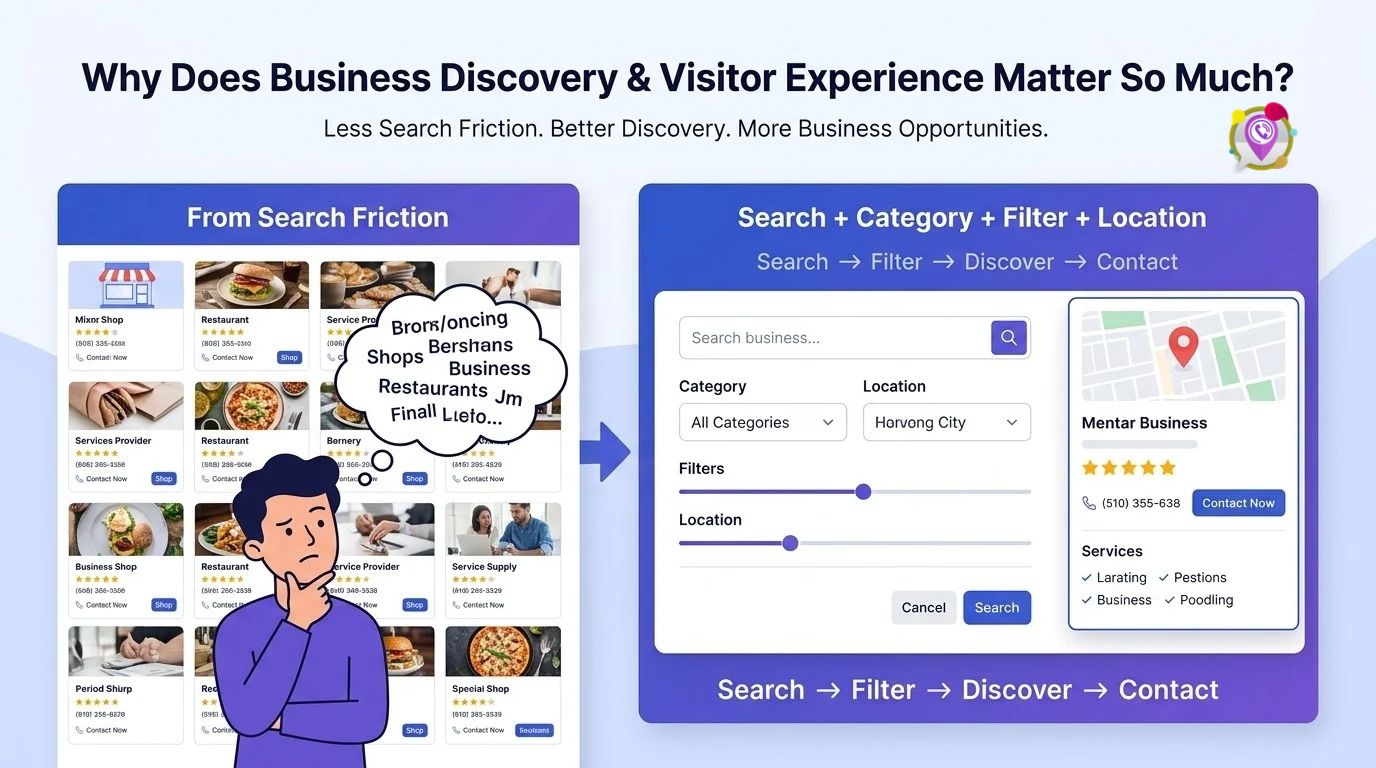
Simple Business Directory (SBD) reduces directory friction by giving visitors structured ways to narrow a large collection of businesses. Simple Business Directory (SBD) can turn an overwhelming list into a discovery path based on what a visitor needs.

Simple Business Directory (SBD) works best when directory navigation answers practical questions such as “Which business provides this service?”, “Which businesses are near this location?”, and “Which listing matches these requirements?”

Simple Business Directory (SBD) can therefore make directory discovery more intentional instead of forcing visitors to scan pages of unrelated listings.

How Can Simple Business Directory (SBD) Turn Browsing Into Discovery?

Simple Business Directory (SBD) can support a visitor journey that looks like:

Search → Category → Filter → Location → Business Listing → Contact or Visit

Simple Business Directory (SBD) makes each stage useful because every stage reduces the number of irrelevant choices presented to the visitor.

Simple Business Directory (SBD) gives directory owners a practical way to think about discovery: every search, category, filter, and location choice should move a visitor closer to a relevant business.

Why Does Business Discovery & Visitor Experience Matter So Much?

Simple Business Directory (SBD) makes Business Discovery & Visitor Experience the first major pillar because directory visitors usually arrive with a specific discovery goal.

Simple Business Directory (SBD) supports a discovery experience where visitors can move through business categories, search results, locations, and individual listings instead of relying entirely on manual browsing.

Why Is Search More Important as Simple Business Directory (SBD) Grows?

Simple Business Directory (SBD) becomes increasingly valuable when a directory contains hundreds or thousands of listings. Simple Business Directory (SBD) can help visitors locate relevant businesses without requiring visitors to inspect every available listing.

Simple Business Directory (SBD) can make search particularly useful when business names, services, locations, or categories provide meaningful search signals. A visitor searching for “Italian restaurant” has a very different discovery intent from a visitor searching for “accountant in Dhaka,” and Simple Business Directory (SBD) can support a directory structure designed around those discovery patterns.

Can Simple Business Directory (SBD) Reduce Directory Search Friction?

Simple Business Directory (SBD) reduces search friction by giving visitors structured ways to narrow business results. Simple Business Directory (SBD) can combine search, categories, filters, and location-based discovery so visitors can move from a large directory collection toward a smaller relevant result set.

Simple Business Directory (SBD) also helps directory owners think beyond listing quantity. A directory containing 1,000 listings can be less useful than a directory containing 300 well-organized listings if visitors cannot find relevant businesses.

How Do Categories Improve Simple Business Directory (SBD) Discovery?

Simple Business Directory (SBD) uses categories as an information-architecture layer that groups businesses according to meaningful business types or services. Simple Business Directory (SBD) categories can reduce the cognitive load created by presenting visitors with a single undifferentiated list.

Simple Business Directory (SBD) category structures should remain intuitive because overly complicated category systems can create another form of navigation friction. Simple Business Directory (SBD) directory owners should use categories that match the language visitors naturally use when looking for businesses.

How Can Simple Business Directory (SBD) Make Local Discovery More Useful?

Simple Business Directory (SBD) can connect business discovery with location-based intent. Simple Business Directory (SBD) becomes especially relevant for directories covering restaurants, service providers, shops, agencies, professionals, healthcare businesses, accommodation providers, and other location-dependent businesses.

Simple Business Directory (SBD) location information can help visitors answer practical questions such as where a business operates, whether a business is nearby, and which businesses serve a particular area.

Why Do Maps Matter in Simple Business Directory (SBD) Discovery?

Simple Business Directory (SBD) can make location information more useful when directory visitors need geographical context. Simple Business Directory (SBD) location and map functionality can complement textual search by showing where businesses are located.

Simple Business Directory (SBD) map-based discovery is particularly useful when proximity influences purchasing decisions. A visitor choosing a restaurant, repair service, clinic, hotel, or local professional may care about distance as much as business category.

What Does a Better Simple Business Directory (SBD) Visitor Journey Look Like?

Simple Business Directory (SBD) can support a visitor journey built around progressively more specific information:

  1. Simple Business Directory (SBD) starts with a broad directory discovery experience.
  2. Simple Business Directory (SBD) narrows discovery through categories.
  3. Simple Business Directory (SBD) narrows results further through search or filters.
  4. Simple Business Directory (SBD) adds location context when location affects relevance.
  5. Simple Business Directory (SBD) presents detailed business information through an individual listing.
  6. Simple Business Directory (SBD) gives visitors the information needed to contact, visit, or investigate the business.

The important point is that Simple Business Directory (SBD) does not need to make every visitor follow the same path. Simple Business Directory (SBD) can support multiple discovery routes because different visitors arrive with different search intent.

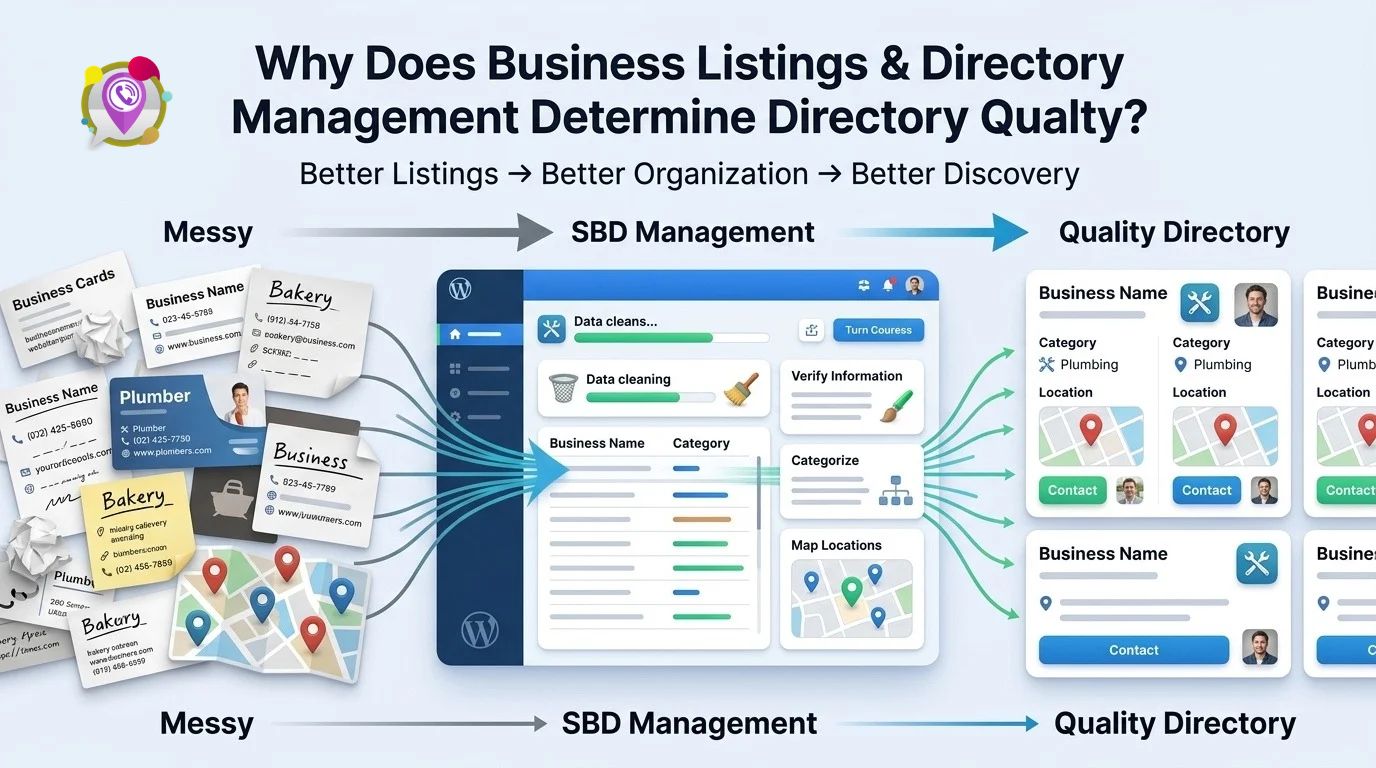
Why Does Business Listings & Directory Management Determine Directory Quality?

Your Business Directory Has Traffic—So Why Aren’t Visitors Finding the Right Businesses

Simple Business Directory (SBD) makes Business Listings & Directory Management the second core pillar because visitor discovery depends on the quality of the underlying business information.

Simple Business Directory (SBD) cannot create useful discovery from incomplete, duplicated, outdated, or poorly categorized business information. Simple Business Directory (SBD) directory management therefore becomes part of the visitor experience rather than a purely administrative task.

Why Aren’t More Simple Business Directory (SBD) Listings Always Better?

Simple Business Directory (SBD) directory growth creates value only when additional listings remain useful and discoverable. Simple Business Directory (SBD) owners should measure directory quality through listing completeness, relevance, organization, and discoverability rather than listing count alone.

Simple Business Directory (SBD) can make a 2,000-listing directory valuable when visitors can efficiently locate relevant businesses. Simple Business Directory (SBD) can also expose the weaknesses of a 2,000-listing directory when categories, locations, descriptions, and search paths are poorly structured.

What Information Should a Simple Business Directory (SBD) Listing Contain?

Simple Business Directory (SBD) listings should contain the information visitors need to evaluate a business. Simple Business Directory (SBD) business profiles can include business names, descriptions, categories, locations, contact information, images, and other relevant business details depending on the directory configuration.

Simple Business Directory (SBD) listing completeness matters because visitors make decisions using information, not listing counts. Simple Business Directory (SBD) gives directory owners a structure for presenting business information in a more consistent format.

How Does Simple Business Directory (SBD) Help Organize Growing Directories?

Simple Business Directory (SBD) can provide a management structure for directories that continue adding businesses over time. Simple Business Directory (SBD) gives directory owners a framework for managing individual business entries rather than treating the directory as a collection of unrelated pages.

Simple Business Directory (SBD) becomes particularly useful when multiple business types, locations, and categories coexist. Simple Business Directory (SBD) organization helps maintain a predictable relationship between directory structure and visitor search intent.

Can Simple Business Directory (SBD) Improve Business Listing Quality?

Simple Business Directory (SBD) can improve listing quality by giving directory owners a consistent structure for business information. Simple Business Directory (SBD) structured listings make it easier for visitors to compare relevant business information across multiple entries.

Simple Business Directory (SBD) listing quality also influences perceived directory credibility. Simple Business Directory (SBD) directories with consistent business information provide visitors with a clearer basis for deciding which businesses deserve further attention.

How Should Simple Business Directory (SBD) Owners Handle Directory Growth?

Simple Business Directory (SBD) owners should treat directory growth as an information-architecture challenge rather than simply an acquisition challenge.

Simple Business Directory (SBD) owners can monitor:

  • Simple Business Directory (SBD) listing completeness for missing or weak business information.
  • Simple Business Directory (SBD) category consistency for businesses assigned to inappropriate categories.
  • Simple Business Directory (SBD) location accuracy for businesses with incomplete or incorrect location information.
  • Simple Business Directory (SBD) duplicate listings for repeated business entries.
  • Simple Business Directory (SBD) search usability for visitors struggling to find relevant businesses.
  • Simple Business Directory (SBD) listing engagement for identifying listings receiving attention from directory visitors.

What Happens When Simple Business Directory (SBD) Has 100, 500, 1,000, or 2,000 Listings?

Simple Business Directory (SBD) requires increasingly deliberate information architecture as directory volume increases.

Directory size Simple Business Directory (SBD) priority Main risk
100 listings Simple Business Directory (SBD) category and listing consistency Weak organization
500 listings Simple Business Directory (SBD) search and filtering Search friction
1,000 listings Simple Business Directory (SBD) structured categories and locations Information overload
2,000+ listings Simple Business Directory (SBD) scalable discovery and management Poor relevance and navigation

Simple Business Directory (SBD) does not make directory size itself the objective. Simple Business Directory (SBD) makes useful discovery the objective, with directory size treated as a factor that increases the importance of organization.

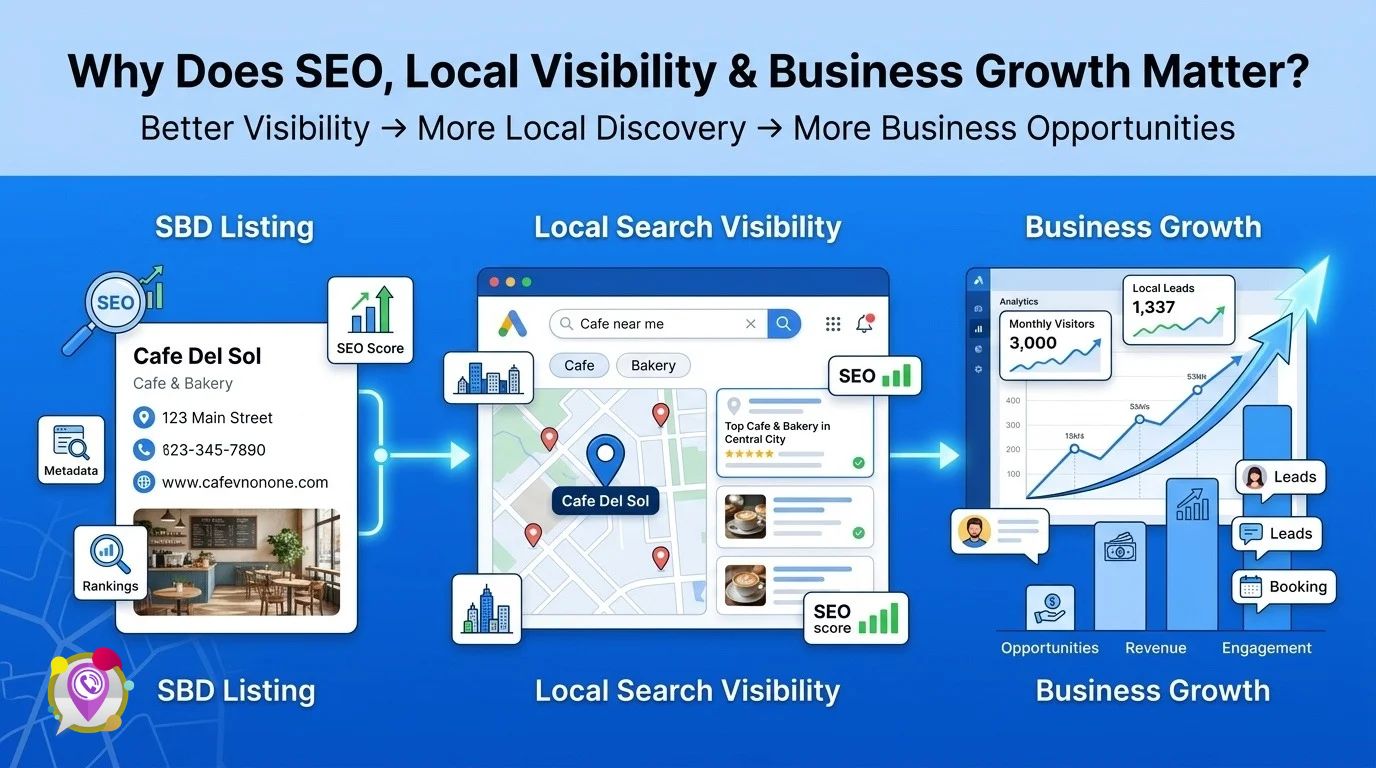
Why Does SEO, Local Visibility & Business Growth Matter?

Why Does SEO, Local Visibility & Business Growth Matter

Simple Business Directory (SBD) makes SEO, Local Visibility & Business Growth the third core pillar because directory discovery does not have to begin on the directory homepage.

Simple Business Directory (SBD) individual business listings can become additional entry points for visitors arriving from search engines. Simple Business Directory (SBD) therefore allows directory architecture to support both internal discovery and external discovery.

How Can Simple Business Directory (SBD) Listings Create More Search Entry Points?

Simple Business Directory (SBD) can create individual business listing pages that target specific business information. Simple Business Directory (SBD) listing pages can potentially match searches involving business names, services, categories, locations, and combinations of those signals.

Simple Business Directory (SBD) creates a fundamentally different SEO structure from a single homepage because individual listings provide additional pages containing business-specific information.

For example, a directory homepage might target a broad query such as “business directory in Dhaka.” Simple Business Directory (SBD) individual listings can provide more specific destinations for searches such as “graphic design agency in Dhaka” or a specific business name.

Can Simple Business Directory (SBD) Support Local SEO Strategy?

Simple Business Directory (SBD) can support local SEO strategy by organizing business information around businesses and locations. Simple Business Directory (SBD) location-aware listing structures can give search engines and visitors more specific information than a generic directory homepage.

Simple Business Directory (SBD) should not be treated as an automatic local SEO guarantee. Simple Business Directory (SBD) provides directory structures and content opportunities, while actual search visibility also depends on content quality, technical SEO, indexing, competition, authority, relevance, and search-engine algorithms.

How Can Simple Business Directory (SBD) Turn Listings Into Business Growth Assets?

Simple Business Directory (SBD) can give listed businesses another digital discovery surface. Simple Business Directory (SBD) can therefore create value for both directory owners and participating businesses.

Simple Business Directory (SBD) directory owners can evaluate business growth using measurable actions rather than vanity metrics.

Useful Simple Business Directory (SBD) metrics include:

  • Simple Business Directory (SBD) listing views for measuring business-page exposure.
  • Simple Business Directory (SBD) search interactions for understanding visitor intent.
  • Simple Business Directory (SBD) category engagement for identifying popular business segments.
  • Simple Business Directory (SBD) location interactions for measuring local discovery interest.
  • Simple Business Directory (SBD) contact actions for connecting directory traffic with business opportunities.
  • Simple Business Directory (SBD) organic landing pages for understanding search-driven discovery.

What Does Simple Business Directory (SBD) ROI Look Like in Real Numbers?

Simple Business Directory (SBD) ROI becomes easier to understand when directory owners connect traffic to measurable business actions.

Consider a Simple Business Directory (SBD) directory receiving 20,000 monthly visitors. If Simple Business Directory (SBD) helps convert only 2% of those visitors into meaningful business-detail interactions, the directory generates approximately 400 high-intent interactions per month.

If 10% of the 400 Simple Business Directory (SBD) interactions result in a contact action, the directory produces approximately 40 business contacts per month.

The calculation is:

20,000 visitors × 2% interaction rate = 400 interactions

400 interactions × 10% contact rate = 40 contacts

Simple Business Directory (SBD) owners can then measure commercial value using:

Monthly directory value = qualified contacts × estimated value per qualified contact

If a qualified contact is worth $25 to a participating business, 40 contacts represent a theoretical $1,000 monthly lead value before accounting for costs, lead quality, attribution, and conversion rates.

Simple Business Directory (SBD) does not guarantee these conversion rates. Simple Business Directory (SBD) provides the directory structure that allows directory owners to measure and improve the journey from visitor discovery toward business interaction.

Why Should Simple Business Directory (SBD) Owners Stop Measuring Success by Traffic Alone?

Simple Business Directory (SBD) traffic is only the first measurement layer. Simple Business Directory (SBD) owners need deeper metrics to understand whether visitors actually discover useful businesses.

Simple Business Directory (SBD) metric What the metric reveals Possible issue
Simple Business Directory (SBD) traffic Directory reach Visitors may have weak intent
Simple Business Directory (SBD) search usage Discovery intent Search may be difficult to use
Simple Business Directory (SBD) listing views Business discovery Listings may not match queries
Simple Business Directory (SBD) contact actions Commercial intent Business information may be incomplete
Simple Business Directory (SBD) organic traffic Search visibility SEO structure may need improvement
Simple Business Directory (SBD) repeat visits Directory usefulness Discovery experience may be weak

Simple Business Directory (SBD) therefore changes the central question from “How much traffic does the directory receive?” to “How efficiently does the directory connect visitors with relevant businesses?”

How Do the Three Simple Business Directory (SBD) Pillars Work Together?

Simple Business Directory (SBD) becomes more effective when the three pillars operate as one system.

Business Discovery & Visitor Experience helps visitors find relevant businesses.

Business Listings & Directory Management ensures visitors find useful and organized business information.

SEO, Local Visibility & Business Growth creates additional opportunities for visitors to discover businesses through search and local intent.

Simple Business Directory (SBD) can therefore be understood through the following chain:

Better Listings → Better Organization → Better Discovery → More Relevant Visits → More Business Opportunities

Simple Business Directory (SBD) does not need every directory owner to pursue the same growth strategy. Simple Business Directory (SBD) gives directory owners a structure that can be adapted to local directories, niche directories, professional directories, service directories, and broader business-discovery websites.

What Technical Architecture Should Simple Business Directory (SBD) Owners Think About?

Simple Business Directory (SBD) directory owners should think about directory architecture at three levels: data, discovery, and delivery.

Simple Business Directory (SBD) data architecture determines how business information is stored and organized.

Simple Business Directory (SBD) discovery architecture determines how visitors locate businesses through search, categories, filters, and locations.

Simple Business Directory (SBD) delivery architecture determines how efficiently WordPress serves directory pages to visitors and search-engine crawlers.

Simple Business Directory (SBD) owners should also avoid treating every technical problem as an SEO problem. Simple Business Directory (SBD) SEO performance can be affected by indexing, canonicalization, duplicate content, page speed, crawlability, internal linking, content quality, and search intent alignment.

What Should a Simple Business Directory (SBD) Optimization Checklist Look Like?

Simple Business Directory (SBD) owners can use the following operational checklist:

  1. Simple Business Directory (SBD) should provide clear business categories.
  2. Simple Business Directory (SBD) should provide useful business listing information.
  3. Simple Business Directory (SBD) should make business discovery intuitive.
  4. Simple Business Directory (SBD) should support relevant search and filtering workflows.
  5. Simple Business Directory (SBD) should organize location information clearly.
  6. Simple Business Directory (SBD) should avoid unnecessary listing duplication.
  7. Simple Business Directory (SBD) should create useful individual listing pages.
  8. Simple Business Directory (SBD) should be monitored for technical SEO problems.
  9. Simple Business Directory (SBD) should measure listing engagement rather than traffic alone.
  10. Simple Business Directory (SBD) should connect directory discovery with measurable business actions.

Why Can a High-Traffic Simple Business Directory (SBD) Still Underperform?

Simple Business Directory (SBD) can receive substantial traffic while producing weak business discovery when visitors cannot quickly identify relevant listings. Simple Business Directory (SBD) traffic becomes more valuable when directory architecture converts broad visits into focused discovery.

Simple Business Directory (SBD) therefore addresses a problem that many directory owners overlook: traffic measures arrival, while discovery measures usefulness.

Simple Business Directory (SBD) gives directory owners a way to build around that distinction by connecting visitor discovery, listing management, and search visibility.

FAQ: What Need to Know About Simple Business Directory (SBD)

Simple Business Directory (SBD) treats visitor discovery as a usability problem rather than a traffic problem.

Simple Business Directory (SBD) reduces search friction by giving visitors structured ways to narrow business results.

Simple Business Directory (SBD) can support a visitor journey that includes search, category, filter, location, business listing, and contact or visit.

Simple Business Directory (SBD) makes Business Discovery & Visitor Experience the first major pillar because directory visitors usually arrive with a specific discovery goal.

Simple Business Directory (SBD) can make location information more useful when directory visitors need geographical context.

Simple Business Directory (SBD) can improve listing quality by giving directory owners a consistent structure for business information.

Simple Business Directory (SBD) privacy compliance depends on the actual information collected, stored, transmitted, and processed by the complete WordPress installation.

Simple Business Directory (SBD) can be evaluated for larger directories by testing the actual expected workload rather than relying on a generic listing-count assumption.

Is Simple Business Directory (SBD) Suitable for a Large Directory With Thousands of Listings?

Simple Business Directory (SBD) can be evaluated for larger directories by testing the actual expected workload rather than relying on a generic listing-count assumption.

Simple Business Directory (SBD) developers should test realistic listing volumes, concurrent visitors, search frequency, filter usage, database size, cache behavior, image delivery, and hosting capacity.

Simple Business Directory (SBD) performance should be measured using metrics such as time to first byte, server response time, database query duration, PHP memory consumption, cache hit rate, and error rate.

Simple Business Directory (SBD) therefore becomes part of a larger WordPress architecture where hosting, database configuration, caching, image optimization, CDN usage, and other plugins can materially affect performance.

Final Takeaway: Is Traffic Really the Problem for Simple Business Directory (SBD)?

Simple Business Directory (SBD) shows why directory success cannot be measured by traffic alone. Simple Business Directory (SBD) connects Business Discovery & Visitor Experience, Business Listings & Directory Management, and SEO, Local Visibility & Business Growth into one directory strategy.

Simple Business Directory (SBD) helps directory owners focus on the more important question: Can visitors quickly find the right businesses after arriving?

Simple Business Directory (SBD) turns that question into three practical priorities:

Discover better. Manage better. Get found better.

Simple Business Directory (SBD) is most valuable when directory owners treat every listing, category, search interaction, location, and business page as part of one connected discovery system.

 

Leave a Reply

Your email address will not be published. Required fields are marked *